UI / UX Design
StuCam
StuCam is a local-first photography booking platform that reduces hiring friction by bringing together photographer discovery, curated portfolios, transparent pricing, availability, and in-app messaging into one seamless mobile experience.
Type :
iOS Mobile App
Timeline :
Aug – Dec 2025
Context :
Master's Capstone — CSU East Bay
Role :
End-to-End UX & Product Designer
Project Background & Personal Journey
StuCam started from a real-life moment when I met a singer on a bus who needed someone to shoot short videos/reels of her performance, but she did not know where to find an affordable and reliable local videographer. That moment made me realize there is a gap between people who need quick creative help and photographers or creators who are looking for real paid opportunities.
StuCam explores how a local-first booking platform can make it easier for clients to discover, compare, and book nearby photographers through portfolios, pricing, availability, and in-app messaging.
The Problem
Hiring a photographer should feel simple, but the current process is often fragmented, informal, and difficult to trust. Clients usually rely on Instagram DMs, word-of-mouth, or Facebook groups, which can make it hard to compare pricing, availability, style, and reliability in one place.
At the same time, beginner and emerging photographers often have the skills to take on real projects, but struggle to find paid gigs, build credibility, and communicate their value professionally.
Problem Statement:
There is no dedicated, local-first platform that helps clients and emerging photographers connect efficiently, affordably, and safely while providing the trust signals needed to feel confident before booking.
Research & Insights
To understand both sides of the marketplace, I combined real-life observation, informal conversations, interview planning, and competitor analysis. I focused on two user groups: clients looking for photography or reel creation services, and photographers offering those services.
I created separate interview guides for clients and photographers, covering topics such as trust, pricing, booking timelines, communication, safety, availability, and shoot preparation. I also reviewed existing options like Instagram, Fiverr, Upwork, and Snappr to understand where current workflows feel fragmented or unreliable.
Key Insights
Trust is the foundation of booking.
Clients need to see real work, reviews, clear pricing, and identity signals before booking someone they do not know.
Availability is often more important than perfection.
For performers, students, and small businesses, the key question is often “Who is available this week?” rather than “Who is the absolute best?”
Pricing transparency reduces friction.
Negotiating through DMs can feel awkward and unprofessional. Visible rates and package pricing make the interaction clearer for both sides.
Beginner photographers need structure to feel professional.
A dashboard, organized portfolio, and managed booking flow help photographers present themselves with more confidence and credibility.
Local discovery matters.
Most shoots happen in person, so distance, location, and nearby availability are important parts of the decision.
Design Translation
These insights directly shaped StuCam’s information architecture and core features: trust signals on photographer profiles, an availability toggle, transparent pricing on cards and detail pages, a photographer dashboard, and a Near You discovery feed.


User Archetypes
Based on the research, I identified four key user archetypes that shaped the design direction for StuCam. These archetypes helped me understand the different motivations, pain points, and expectations across both sides of the marketplace.
Portfolio Builder
A beginner photographer who wants real-world experience, paid gigs, and portfolio credibility.
Needs: visibility, trust, client opportunities
Pain point: people hesitate to book them without proof of experience
Opportunity: curated portfolio, reviews, and profile credibility
Budget Creator
A student, artist, or small business owner who needs affordable photography or reel content.
Needs: clear pricing, reliable options, simple booking
Pain point: professional services feel too expensive or hard to compare
Opportunity: transparent rates, filters, and local photographer discovery
Event Improviser
A performer, musician, or creator who needs someone available quickly for a shoot or event.
Needs: fast availability, location-based discovery, quick communication
Pain point: last-minute creative needs are hard to solve through DMs
Opportunity: availability toggle, Near You feed, and instant messaging
Side-Hustler
A photographer who wants flexible paid work while balancing school, work, or other commitments.
Needs: flexible scheduling, booking control, income opportunities
Pain point: inconsistent client flow and unclear expectations
Opportunity: booking dashboard, availability calendar, and structured client requests
User Personas
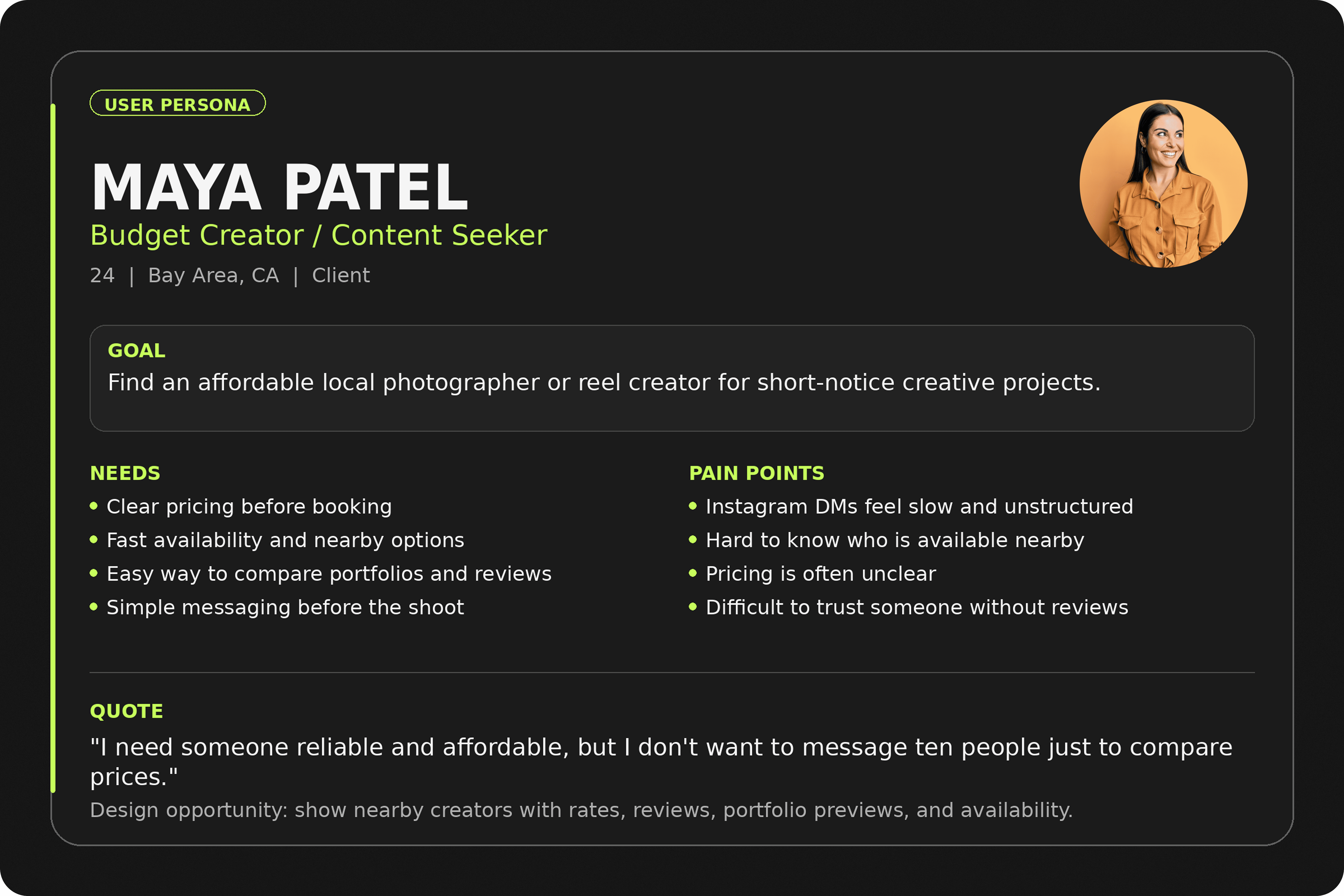
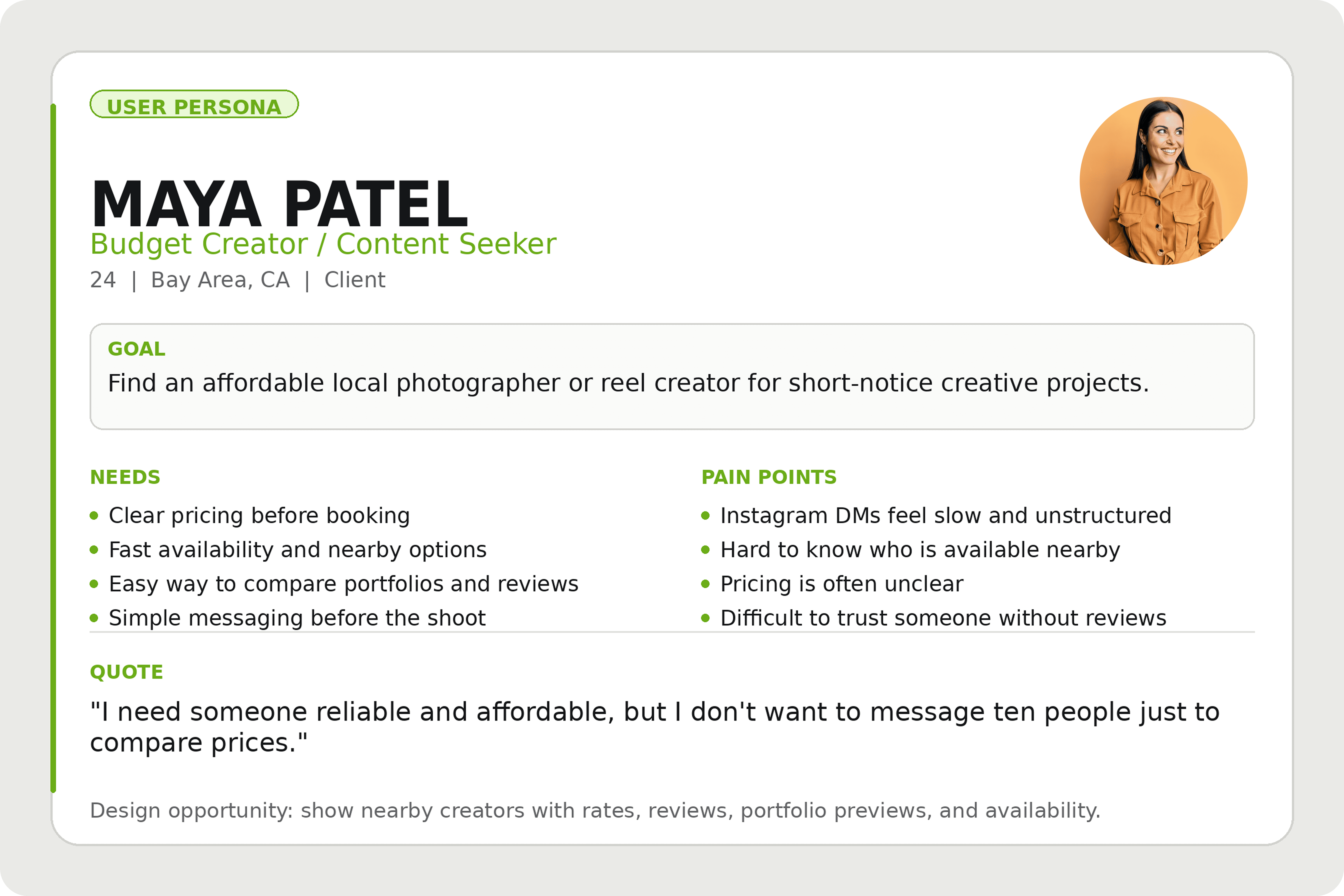
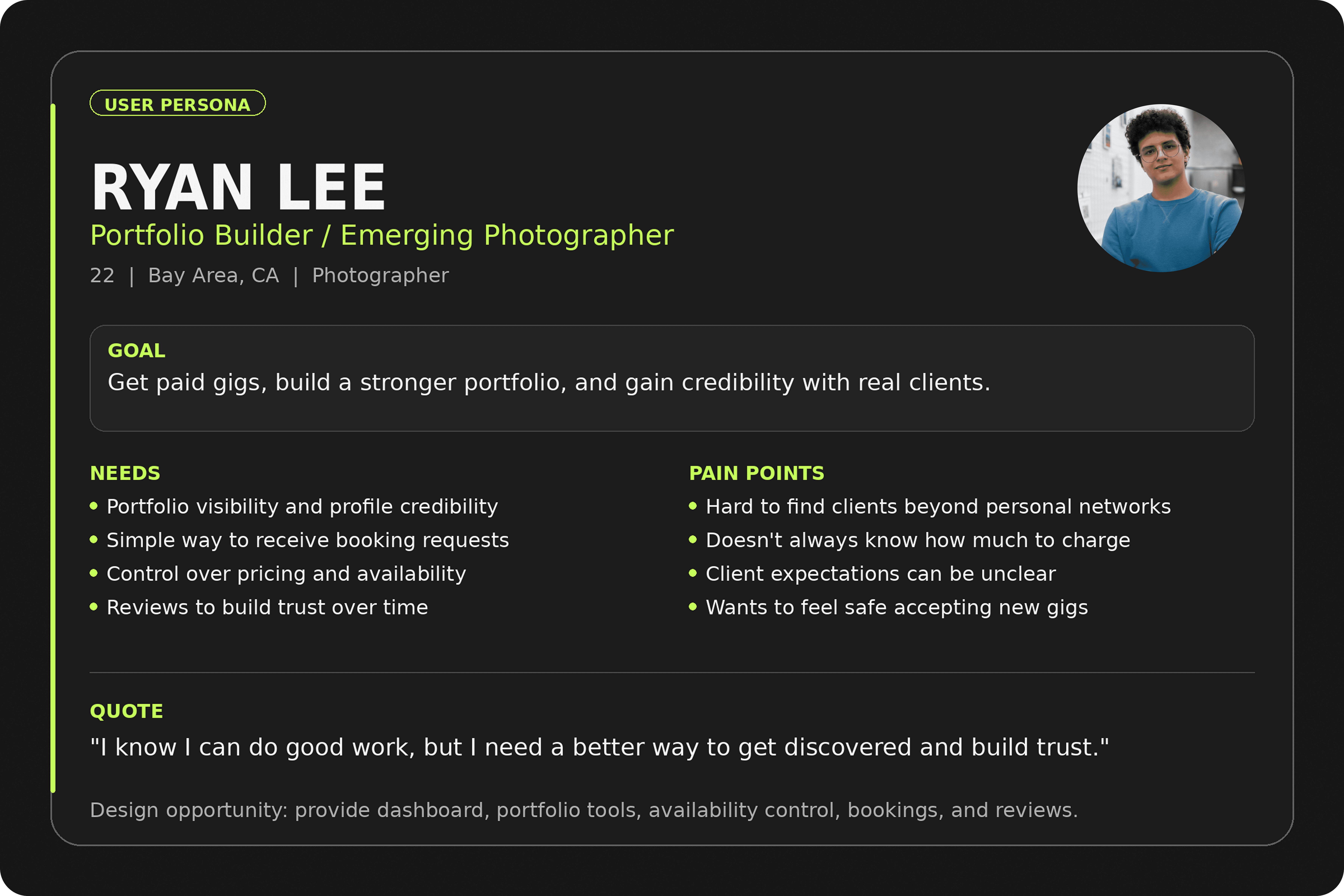
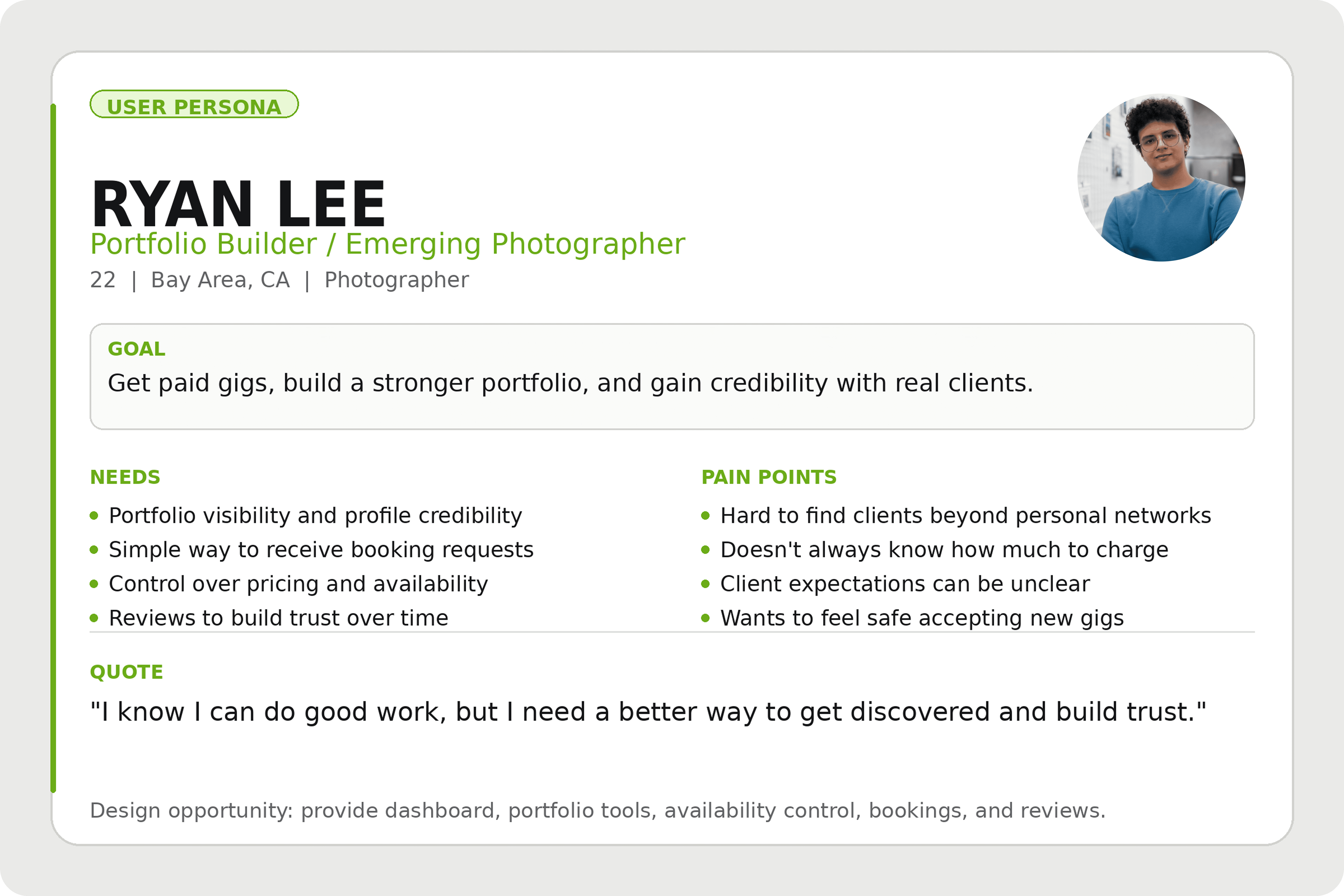
To make the research more specific, I created two core personas representing both sides of the marketplace: the client who needs affordable creative help, and the photographer who wants real opportunities to build experience and credibility.
Persona 1: Client
Persona 2: Photographer
Design Goals
Based on the research insights and user personas, I defined five design goals to guide StuCam’s product experience. These goals helped translate user needs into clear interaction and interface decisions.
Fast Local Discovery
Help clients quickly find nearby photographers or reel creators without searching across multiple platforms.
Trust Before Booking
Make portfolios, reviews, pricing, and availability visible early so clients feel confident before booking.
Clear Booking Flow
Create a simple path from discovery to profile viewing, booking, and messaging.
Photographer Growth
Give photographers tools to showcase work, manage availability, receive requests, and build credibility.
One App, Two Roles
Support both clients and photographers in one unified app with role-based experiences.
Mapping the Core Experience
After defining the research insights and personas, I mapped two primary user flows: one for clients looking to book photographers, and one for photographers managing their services. These flows helped clarify the key screens, actions, and decision points needed in the app.
Client Flow
Explore
→
Filter
→
View Profile
→
Book
→
Message
→
Review
Clients move from discovering nearby photographers to filtering options, reviewing profiles, booking a shoot, confirming details through messages, and leaving a review after the session.
Photographer Flow
Create Profile
→
Set Availability
→
Receive Request
→
Accept Booking
→
Manage Shoot
→
Build Reputation
Photographers move from setting up their profile and availability to receiving booking requests, coordinating with clients, managing shoots, and building credibility through completed work and reviews.
How this shaped the product
Mapping these flows helped define the app’s main navigation (Home, Feed, Bookings, Messages, Profile) and clarified the need for role-based experiences inside one unified app. For clients, the experience focuses on fast discovery and confident booking. For photographers, it focuses on visibility, availability control, booking management, and reputation building.
The Solution
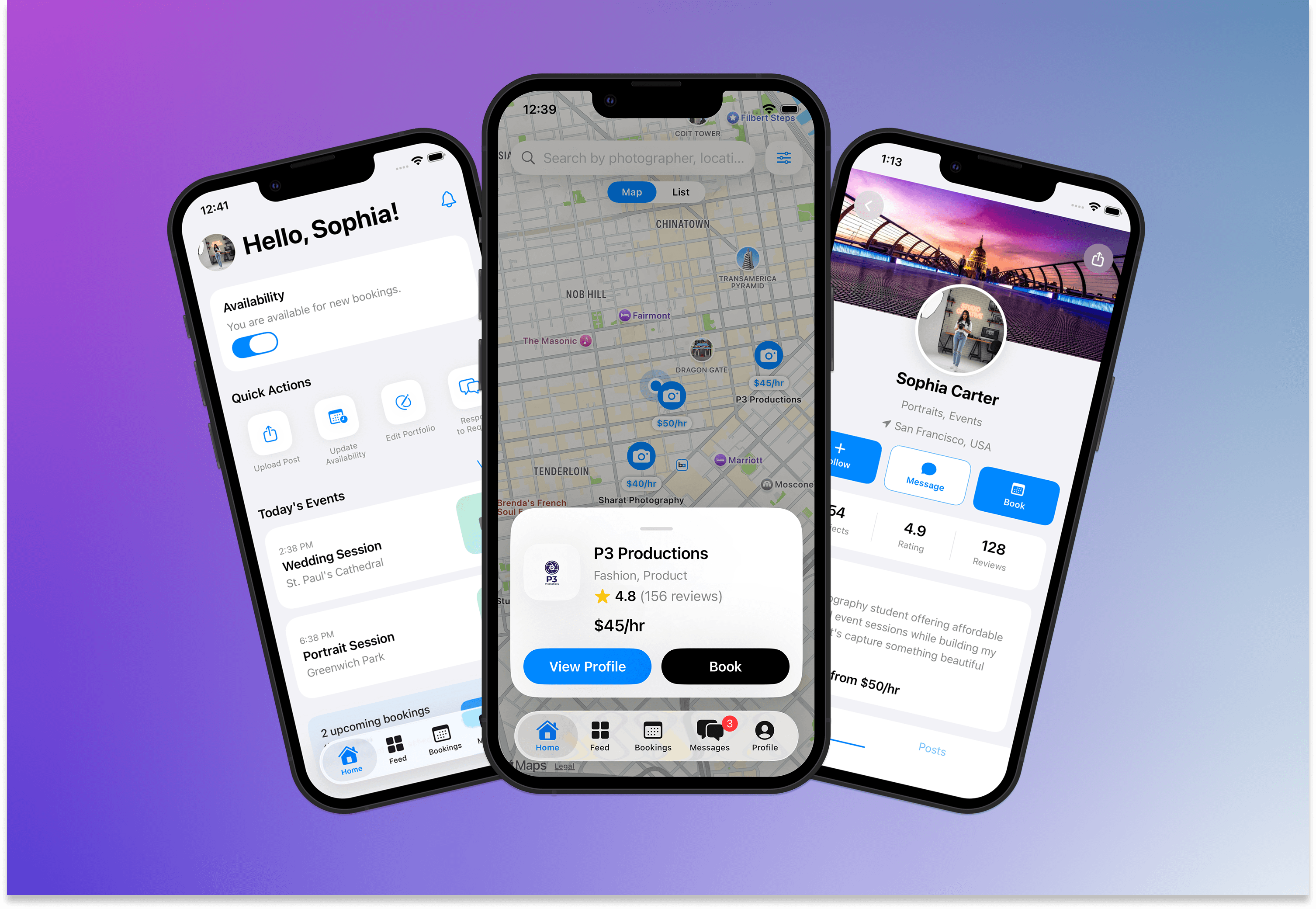
StuCam is a single iOS app with two role-based experiences. After onboarding, users choose whether they're booking a photographer or offering services, and the app reshapes itself around that choice — one product, two clear flows.
Client flow: explore → filter → view profile → book → message → shoot → review. Clients discover photographers via a list / map view, filter by style, price, distance, rating, and availability, and book directly from a profile with an estimated total visible before confirming.
Photographer flow: create profile → upload portfolio → set pricing & availability → receive booking requests → accept / decline → message → complete shoot → gain review. A dashboard surfaces availability, today's bookings, and recent activity.
Bottom navigation is kept simple across both roles: Home, Feed, Bookings, Messages, Profile. Key design decisions that shaped the final product:
One app instead of two, with a role switch — simpler product, easier to scale
"Bookings" tab name over "Calendar" or "Activity" — action-oriented for both roles
Feed tabs: Following / Trending / Near You — reinforces the local-discovery goal
Portfolio separated from Posts — curated work supports booking decisions; lighter posts keep profiles active and discoverable
Booking-first messaging — conversations tied to real commitments are prioritized in the inbox over social chatter
Build, Outcome & Next Steps
StuCam moved from Figma into an iOS build. I designed the screens and flows in Figma, used Cursor / Vibe coding to generate SwiftUI views matching the design direction, then refined layouts, navigation, and UI states in Xcode using simulated data for photographers, bookings, messages, and availability.
What's working today
High-fidelity prototype covering onboarding & role selection
Client discovery, filtering, profile review, and booking flow
Photographer dashboard, portfolio management, and availability toggle
Simulated messaging and booking states (Pending / Upcoming / Completed)
Honest limitations
Payment flow has not yet been designed
Backend is simulated — real-time messaging and availability aren't live
Map-based discovery is represented conceptually, not fully implemented
User testing is still in progress with a small sample size
Next steps
Short-term: structured usability tests with 3–4 clients and 3–4 photographers, refine the booking flow from feedback, design payment & payout screens, prepare a TestFlight build for real-device testing
Long-term: real backend for accounts, profiles, bookings, and messages; real-time map / location discovery; verification badges and stronger safety features; expansion beyond photographers to videographers and reel creators; recommendation features by style, budget, and location
What I took away
This project let me practice the full product design process end-to-end: identifying a real problem, conducting research, synthesizing insights, building user flows, making key design decisions, and translating the prototype into an early SwiftUI build. More importantly, it taught me how product design can support creative communities by turning informal, messy interactions into clear and meaningful experiences.
More Projects


Tools:
UI / UX Design
StuCam
StuCam is a local-first photography booking platform that reduces hiring friction by bringing together photographer discovery, curated portfolios, transparent pricing, availability, and in-app messaging into one seamless mobile experience.
Type :
iOS Mobile App
Timeline :
Aug – Dec 2025
Context :
Master's Capstone — CSU East Bay
Role :
End-to-End UX & Product Designer
Project Background & Personal Journey
StuCam started from a real-life moment when I met a singer on a bus who needed someone to shoot short videos/reels of her performance, but she did not know where to find an affordable and reliable local videographer. That moment made me realize there is a gap between people who need quick creative help and photographers or creators who are looking for real paid opportunities.
StuCam explores how a local-first booking platform can make it easier for clients to discover, compare, and book nearby photographers through portfolios, pricing, availability, and in-app messaging.
The Problem
Hiring a photographer should feel simple, but the current process is often fragmented, informal, and difficult to trust. Clients usually rely on Instagram DMs, word-of-mouth, or Facebook groups, which can make it hard to compare pricing, availability, style, and reliability in one place.
At the same time, beginner and emerging photographers often have the skills to take on real projects, but struggle to find paid gigs, build credibility, and communicate their value professionally.
Problem Statement:
There is no dedicated, local-first platform that helps clients and emerging photographers connect efficiently, affordably, and safely while providing the trust signals needed to feel confident before booking.
Research & Insights
To understand both sides of the marketplace, I combined real-life observation, informal conversations, interview planning, and competitor analysis. I focused on two user groups: clients looking for photography or reel creation services, and photographers offering those services.
I created separate interview guides for clients and photographers, covering topics such as trust, pricing, booking timelines, communication, safety, availability, and shoot preparation. I also reviewed existing options like Instagram, Fiverr, Upwork, and Snappr to understand where current workflows feel fragmented or unreliable.
Key Insights
Trust is the foundation of booking.
Clients need to see real work, reviews, clear pricing, and identity signals before booking someone they do not know.
Availability is often more important than perfection.
For performers, students, and small businesses, the key question is often “Who is available this week?” rather than “Who is the absolute best?”
Pricing transparency reduces friction.
Negotiating through DMs can feel awkward and unprofessional. Visible rates and package pricing make the interaction clearer for both sides.
Beginner photographers need structure to feel professional.
A dashboard, organized portfolio, and managed booking flow help photographers present themselves with more confidence and credibility.
Local discovery matters.
Most shoots happen in person, so distance, location, and nearby availability are important parts of the decision.
Design Translation
These insights directly shaped StuCam’s information architecture and core features: trust signals on photographer profiles, an availability toggle, transparent pricing on cards and detail pages, a photographer dashboard, and a Near You discovery feed.
User Archetypes
Based on the research, I identified four key user archetypes that shaped the design direction for StuCam. These archetypes helped me understand the different motivations, pain points, and expectations across both sides of the marketplace.
Portfolio Builder
A beginner photographer who wants real-world experience, paid gigs, and portfolio credibility.
Needs: visibility, trust, client opportunities
Pain point: people hesitate to book them without proof of experience
Opportunity: curated portfolio, reviews, and profile credibility
Budget Creator
A student, artist, or small business owner who needs affordable photography or reel content.
Needs: clear pricing, reliable options, simple booking
Pain point: professional services feel too expensive or hard to compare
Opportunity: transparent rates, filters, and local photographer discovery
Event Improviser
A performer, musician, or creator who needs someone available quickly for a shoot or event.
Needs: fast availability, location-based discovery, quick communication
Pain point: last-minute creative needs are hard to solve through DMs
Opportunity: availability toggle, Near You feed, and instant messaging
Side-Hustler
A photographer who wants flexible paid work while balancing school, work, or other commitments.
Needs: flexible scheduling, booking control, income opportunities
Pain point: inconsistent client flow and unclear expectations
Opportunity: booking dashboard, availability calendar, and structured client requests
User Personas
To make the research more specific, I created two core personas representing both sides of the marketplace: the client who needs affordable creative help, and the photographer who wants real opportunities to build experience and credibility.
Persona 1: Client
Persona 2: Photographer
Design Goals
Based on the research insights and user personas, I defined five design goals to guide StuCam’s product experience. These goals helped translate user needs into clear interaction and interface decisions.
Fast Local Discovery
Help clients quickly find nearby photographers or reel creators without searching across multiple platforms.
Trust Before Booking
Make portfolios, reviews, pricing, and availability visible early so clients feel confident before booking.
Clear Booking Flow
Create a simple path from discovery to profile viewing, booking, and messaging.
Photographer Growth
Give photographers tools to showcase work, manage availability, receive requests, and build credibility.
One App, Two Roles
Support both clients and photographers in one unified app with role-based experiences.
Mapping the Core Experience
After defining the research insights and personas, I mapped two primary user flows: one for clients looking to book photographers, and one for photographers managing their services. These flows helped clarify the key screens, actions, and decision points needed in the app.
Client Flow
Explore
→
Filter
→
View Profile
→
Book
→
Message
→
Review
Clients move from discovering nearby photographers to filtering options, reviewing profiles, booking a shoot, confirming details through messages, and leaving a review after the session.
Photographer Flow
Create Profile
→
Set Availability
→
Receive Request
→
Accept Booking
→
Manage Shoot
→
Build Reputation
Photographers move from setting up their profile and availability to receiving booking requests, coordinating with clients, managing shoots, and building credibility through completed work and reviews.
How this shaped the product
Mapping these flows helped define the app’s main navigation (Home, Feed, Bookings, Messages, Profile) and clarified the need for role-based experiences inside one unified app. For clients, the experience focuses on fast discovery and confident booking. For photographers, it focuses on visibility, availability control, booking management, and reputation building.
The Solution
StuCam is a single iOS app with two role-based experiences. After onboarding, users choose whether they're booking a photographer or offering services, and the app reshapes itself around that choice — one product, two clear flows.
Client flow: explore → filter → view profile → book → message → shoot → review. Clients discover photographers via a list / map view, filter by style, price, distance, rating, and availability, and book directly from a profile with an estimated total visible before confirming.
Photographer flow: create profile → upload portfolio → set pricing & availability → receive booking requests → accept / decline → message → complete shoot → gain review. A dashboard surfaces availability, today's bookings, and recent activity.
Bottom navigation is kept simple across both roles: Home, Feed, Bookings, Messages, Profile. Key design decisions that shaped the final product:
One app instead of two, with a role switch — simpler product, easier to scale
"Bookings" tab name over "Calendar" or "Activity" — action-oriented for both roles
Feed tabs: Following / Trending / Near You — reinforces the local-discovery goal
Portfolio separated from Posts — curated work supports booking decisions; lighter posts keep profiles active and discoverable
Booking-first messaging — conversations tied to real commitments are prioritized in the inbox over social chatter
Build, Outcome & Next Steps
StuCam moved from Figma into an iOS build. I designed the screens and flows in Figma, used Cursor / Vibe coding to generate SwiftUI views matching the design direction, then refined layouts, navigation, and UI states in Xcode using simulated data for photographers, bookings, messages, and availability.
What's working today
High-fidelity prototype covering onboarding & role selection
Client discovery, filtering, profile review, and booking flow
Photographer dashboard, portfolio management, and availability toggle
Simulated messaging and booking states (Pending / Upcoming / Completed)
Honest limitations
Payment flow has not yet been designed
Backend is simulated — real-time messaging and availability aren't live
Map-based discovery is represented conceptually, not fully implemented
User testing is still in progress with a small sample size
Next steps
Short-term: structured usability tests with 3–4 clients and 3–4 photographers, refine the booking flow from feedback, design payment & payout screens, prepare a TestFlight build for real-device testing
Long-term: real backend for accounts, profiles, bookings, and messages; real-time map / location discovery; verification badges and stronger safety features; expansion beyond photographers to videographers and reel creators; recommendation features by style, budget, and location
What I took away
This project let me practice the full product design process end-to-end: identifying a real problem, conducting research, synthesizing insights, building user flows, making key design decisions, and translating the prototype into an early SwiftUI build. More importantly, it taught me how product design can support creative communities by turning informal, messy interactions into clear and meaningful experiences.
More Projects
Tools: